Product updates
Miris and Voxel51: High-fidelity 3D streaming meets visual AI

Will McDonald
March 17, 2026
•
5 min read

Physical AI teams don't lack spatial data. They lack a practical way to work with it.
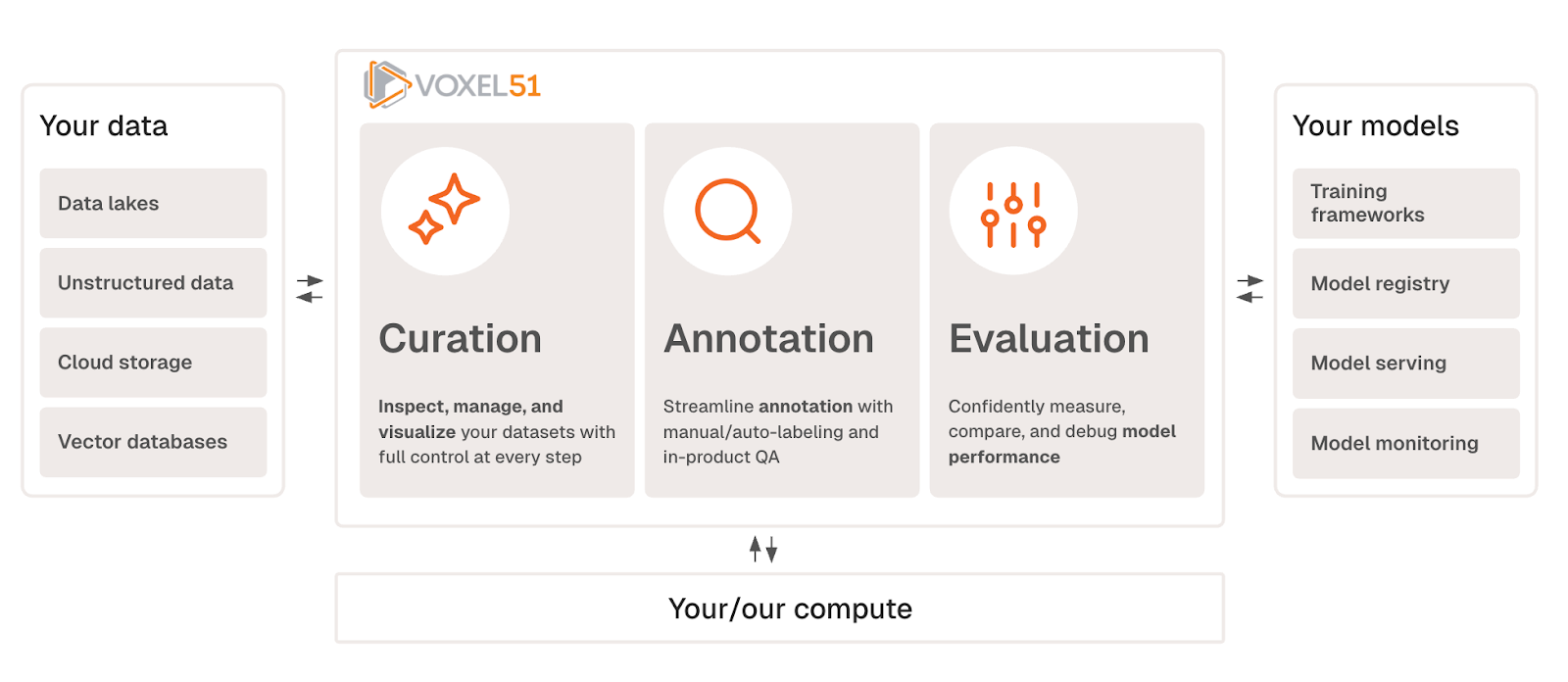
The 3D reconstructions exist. Sensor fusion pipelines produce dense point clouds, volumetric data, and mesh representations from LiDAR, camera, and radar inputs. Physical AI data development platforms like Voxel51 enable development teams to curate, annotate, and evaluate model outputs so they can understand their data, identify failure modes, edge cases, and prioritize the right data for training across images, video, 3D, and other modalities.
But when it's time to visualize a 3D reconstruction at full fidelity, the workflow stalls. Loading a complex spatial scene locally demands high-end GPU hardware. Sharing that scene with a colleague means shipping multi-gigabyte files or standing up custom pixel streaming infrastructure. Switching between hundreds or thousands of reconstructions is slow. Scaling visualization across a team of ten engineers means ten expensive GPU workstations, or long waits as assets download and decompress.
This is the last-mile problem for spatial data. The content is ready. The tools to curate and evaluate it are ready. But the path from data in a pipeline to content you can see, inspect, and act on still carries too much friction. That gap is what Miris and Voxel51 are solving together.
Miris is building a spatial streaming integration for FiftyOne. The integration brings streamed, high-fidelity 3D content directly into the workspace where teams already inspect and evaluate their data.
In practice, this means opening a FiftyOne sample and quickly seeing a full spatial reconstruction rather than a static point cloud preview or a long loading 3D file download. The assets stream in real time and adapt dynamically to provide the best possible visuals and experience. Ground truth labels, metadata, model predictions, and experiment state remain visible in context alongside the 3D view.
No cloud GPU is required for viewing. No multi-gigabyte downloads. First demos of the integration are planned around June 2026, and teams interested in early access can sign up through the Miris Public Beta.
Miris streams actual 3D spatial data (not pre-rendered pixels or video) to any device. Teams upload assets in standard formats like OpenUSD. Miris conditions each asset through an AI optimization pipeline that converts it into a field-based spatial representation designed for progressive streaming delivery. Content loads as quickly as a video thumbnail, then sharpens continuously as the stream adapts to device and network conditions.
At the point of delivery, there are no per-user cloud GPU dependencies. Content distributes through a CDN-style architecture, and costs scale with the number of views rather than concurrent rendering sessions. The streaming protocol adapts in real time across four dimensions: network conditions, device capabilities, content complexity, and user interaction.
Critically, Miris streams only the spatial data relevant to the current view rather than requiring the full dataset in memory. This makes it both faster to first interaction and more memory efficient than local bulk data loading. For Physical AI workloads where GPU memory is often the binding constraint, this changes the calculus on how many parallel simulations, inspections, or visualizations a team can run on the same hardware. Content that requires multi-gigabyte local files today becomes an instant, lightweight stream.
Autonomous systems scene review. A self-driving team reconstructs an urban intersection mesh generated from a drive. Today, reviewing that scene at full resolution means downloading GBs ranging up to TBs worth of assets to a local workstation or pixel streaming with a cloud GPU. With Miris streaming inside FiftyOne, the same reconstruction opens in a browser tab alongside the dataset's annotations and model predictions. The team reviews the issues, compares scene versions, and finds the right samples to build the most optimal training dataset, all without leaving FiftyOne. AV companies like Porsche are using FiftyOne to generate reconstructions and scene variations for their synthetic data generation pipeline
Manufacturing and defect inspection. A QA team captures high-resolution 3D scans of components on a production line. Reviewing individual scan anomalies in FiftyOne today means loading local artifacts with limited resolution. With Miris, full-fidelity scans stream on demand. Switching between samples takes seconds instead of minutes. Engineers visually inspect surface detail, slice by defect types, and surface poor-quality samples, outliers, and data gaps to curate a targeted sample set for training runs.
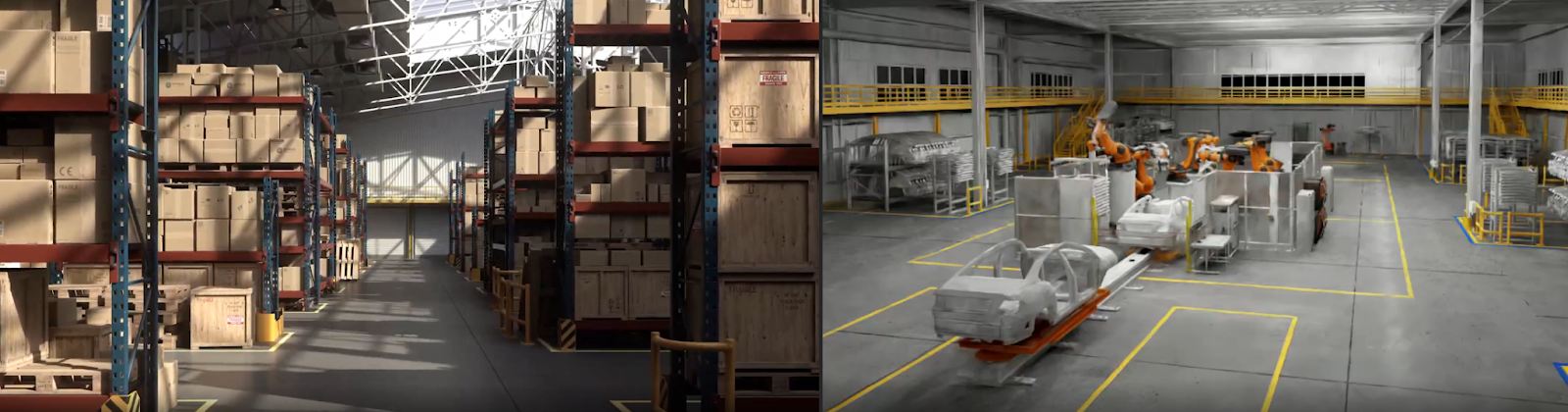
Robotics simulation distribution. A robotics team builds photorealistic simulation environments for training VLA models. Today, reviewing each simulation instance requires loading the full 3D dataset into GPU memory, which caps the number of parallel runs a team can execute on a given hardware budget. Miris streams only the spatial data needed at any given moment, allowing teams to quickly identify the critical paths to success using efficient streaming coupled with FiftyOne’s data management and curation. Companies such as Berkshire Grey are building robotics solutions with FiftyOne to automate their picking, sorting, and transferring tasks in warehouses.
The Miris Public Beta launches March 24. Sign up to upload your first asset and stream it to any device, no cloud GPU required. Beta access is free and includes full SDK support for web (three.js) and Unity. The FiftyOne integration is in active development. Get the first to be notified by signing up for early access.
If you are looking to create 3D reconstructions, explore the FiftyOne Physical AI Workbench.Learn more about FiftyOne and its growing capabilities for 3D data workflows.

Streaming video reshaped media consumption; we're doing the same for 3D. Join a small team solving tough spatial streaming, content delivery, and developer experience challenges.


Technical deep-dives on adaptive spatial streaming, the infrastructure challenges of 3D at scale, and what we're learning as we build. Written by the team doing the work.