Industry trends
The configurator tax: why great 3D never ships

Doug Smith
February 25, 2026
•
8 min read

Every configurator project starts the same way. A client approves a photorealistic render. Your team quotes the build. Then reality sets in.
The source assets arrive: CAD files with millions of polygons, artist builds with detail baked into geometry the camera will never see, marketing renders that look incredible but would take 30 seconds to load on a phone. None of it can ship as-is.
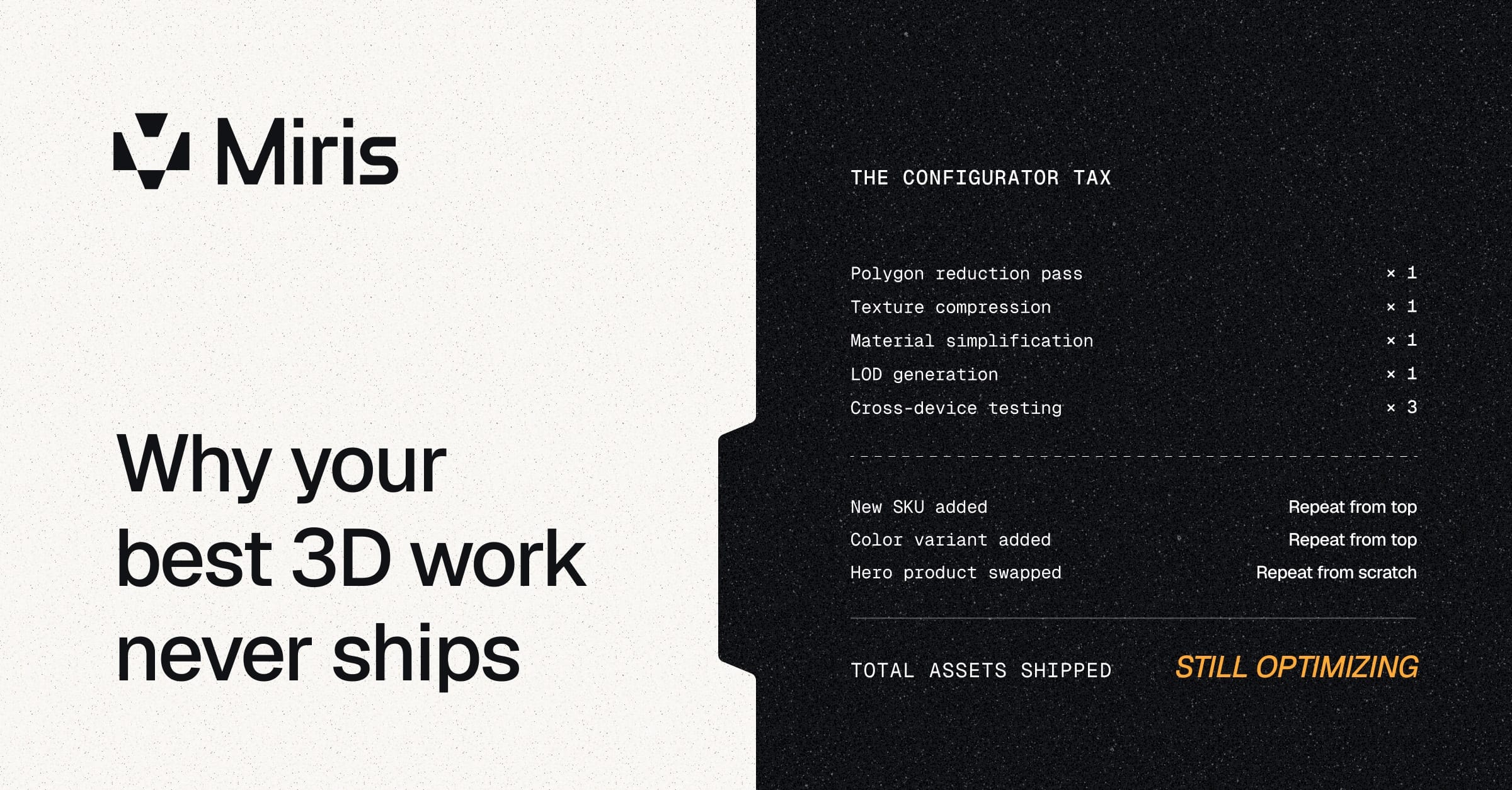
So the real work begins. Polygon reduction. Texture compression. Material simplification. LOD generation. Testing across a stack of devices, finding the problems, optimizing again. And then the conversation nobody enjoys: explaining to the client why the configurator won't look like the render they signed off on.
This is the configurator tax. Not a failure of skill or tooling. A structural cost imposed by delivery infrastructure that was never designed for what clients actually want.
The optimization pass isn't a one-time cost. It's a recurring toll on every change.
New SKU? Run the optimization pipeline. New color variant? Same pipeline. Client swaps the hero product after launch? Same pipeline, from scratch. Every change flows back through the same bottleneck, and that bottleneck is your team's time and attention.
It also creates a persistent tension with content partners. Artists build at production quality because that's their job. Then they're told to strip it down. Then the client sees the stripped-down version and asks why it doesn't look like the render. This loop repeats on every project.
And the constraint doesn't just cost time. It costs outcomes. When a client asks for an environment (a living room for the furniture, a lifestyle context that tells their brand story) the answer is usually no. Not because it's technically impossible, but because the polygon budget is already spent on the product itself. The product would have to get simpler to make room for context.
That matters commercially. 3D product configurators increase conversion rates by up to 40% over static imagery, and branded lifestyle contexts are a key driver of that lift. Stripping context to meet load-time budgets directly erodes the ROI that justified the configurator investment in the first place.
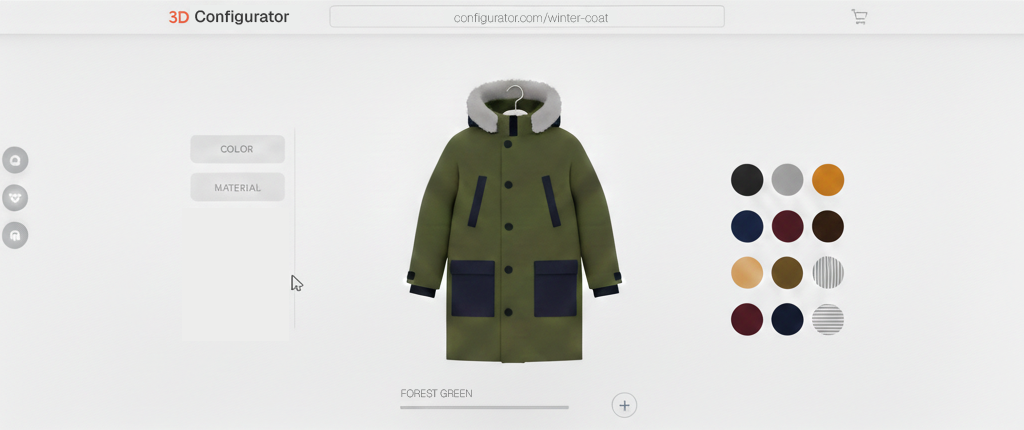
The industry has settled into two approaches, and neither solves the fundamental problem.
Optimize hard, accept the tradeoffs. Target the lowest-common-denominator device. Ship assets that load fast but look generic. Manage client expectations downward. Hope the functionality carries the experience even though the fidelity doesn't. This is where most configurator work lives today, and it's why so many 3D product experiences feel interchangeable despite the enormous effort behind them.
Pixel streaming for premium projects. Render on cloud GPUs, stream the pixels to the browser. Beautiful results. But the economics only work for prestige projects with deep budgets and low concurrent user counts. A single concurrent user session costs real GPU time. Scale that across a product catalog getting thousands of daily visitors and the numbers get uncomfortable fast. It's hard to offer to mid-market clients, and even enterprise clients push back on the cost model.
Both paths leave teams managing constraints instead of building experiences. One sacrifices fidelity for reach. The other sacrifices reach for fidelity. Neither delivers fast, high-fidelity 3D that scales across devices without punitive infrastructure costs.
There's a third option that didn't exist until recently. Instead of optimizing content to be lightweight enough for traditional delivery, or renting cloud GPUs to render it remotely, what if the content itself was converted into a format designed from the ground up for adaptive streaming to the GPU already in every user's device?
That's the architecture Miris built. Any 3D content, regardless of source complexity, is preprocessed through an AI-driven pipeline into a streaming-native format. The end user's device requests exactly the data it needs, when it needs it, adapting in real time based on its own GPU capabilities and network conditions. No polygon budgets. No device-tier testing matrices. No cloud GPU dependencies.
Here's what that shift looks like in practice for configurator teams:
Source assets go straight to processing. Upload the production-quality asset. The system handles optimization as automated infrastructure. No more polygon reduction passes. No more texture compression negotiations. No more "will this run on an iPhone SE?" testing cycles.
Artists build once. The marketing render and the real-time asset become the same thing. Your content partners build at the quality level that makes sense for the product, and that's what ships. The "strip it down" conversation disappears.
Load times become predictable. Assets display instantly and refine progressively. A detailed product inside a branded environment loads just as fast as a simple product floating in a void. Source complexity is no longer a variable in your SLA calculations.
Environments become viable. When you're not fighting for every polygon, you can finally put products in context. The lifestyle scenes clients have been asking for. The branded showrooms that tell a story. Products in places, not floating in space.
Detail scales up, not down. Deliver 5x the geometric detail over traditional real-time rendering. For products where it matters (luxury goods, technical equipment, high-end furniture) capture every surface pore, every fabric texture, every stitch. Rendered intelligently on mobile. The gap between the offline render and the live experience closes.
New SKUs are incremental. Adding another product or color variant is upload, process, ship. No full optimization pass required. The marginal cost of expanding a configurator drops by an order of magnitude.
Costs scale with usage, not infrastructure. No cloud GPU line items. Enterprise clients deploy in their own cloud accounts on a consumption basis, like any other infrastructure service. The economics align with actual value delivered rather than peak-capacity GPU reservations.
Miris provides SDKs for Three.js and Unity, with additional engine integrations available on request. DCC plugins let artists publish directly from their existing tools. The processing pipeline runs as a managed cloud service or deploys into enterprise cloud accounts for customers who need that level of control.
Asset security is built in. The streaming format cannot be extracted or repurposed by end users, which addresses a concern that comes up in nearly every enterprise procurement conversation around 3D product data.
The configurator tax isn't inevitable. It's an artifact of delivery infrastructure that forces a choice between speed and fidelity, between reach and quality. Streaming architecture eliminates that choice.
If your team is spending more time negotiating polygon budgets than building the experiences your clients actually want, that's worth a conversation.
Talk to our team about what’s possible
Interested in joining our beta? Sign up here.