Product updates
The missing layer in collaborative 3D

Will McDonald
April 14, 2026
•
5 min read

Here is what a collaborative 3D review usually looks like in practice.
Someone shares a screen. Someone else takes a screenshot and marks it up in Figma. Notes accumulate in Slack, in a call recording, or in a follow-up email. By the time the review is over, the feedback is real but the connection between that feedback and the actual geometry is fragile. It lives in people's heads, in annotated screenshots that don't show material response, and in comment threads that lose context within days.
This is not just a workflow problem. It is a fidelity problem caused by the way 3D content has been delivered. Getting high-quality 3D into a collaborative environment has required either stripping the asset down to something small enough to share, or setting up GPU-heavy local sessions that not everyone on the team can join. Neither option is satisfying. Both slow down review cycles.
The tradeoff feels inevitable because, until recently, it was.
Miris is integrating its 3D spatial streaming layer with Cavrnus, a platform designed to turn 3D applications and digital twin environments into persistent, multi-user collaborative spaces. The integration brings high-fidelity streaming into the collaborative environment directly, so teams can review, annotate, and iterate on 3D assets together inside a shared space rather than relying on flattened proxies or disconnected tools.
The core idea is straightforward: Cavrnus provides the collaborative environment (persistent session state, multi-user presence, voice and video, synchronized objects), and Miris provides the streaming layer that delivers the actual asset into that environment. Neither platform alone solves the full problem. Together, they eliminate the tradeoff between presence and fidelity.
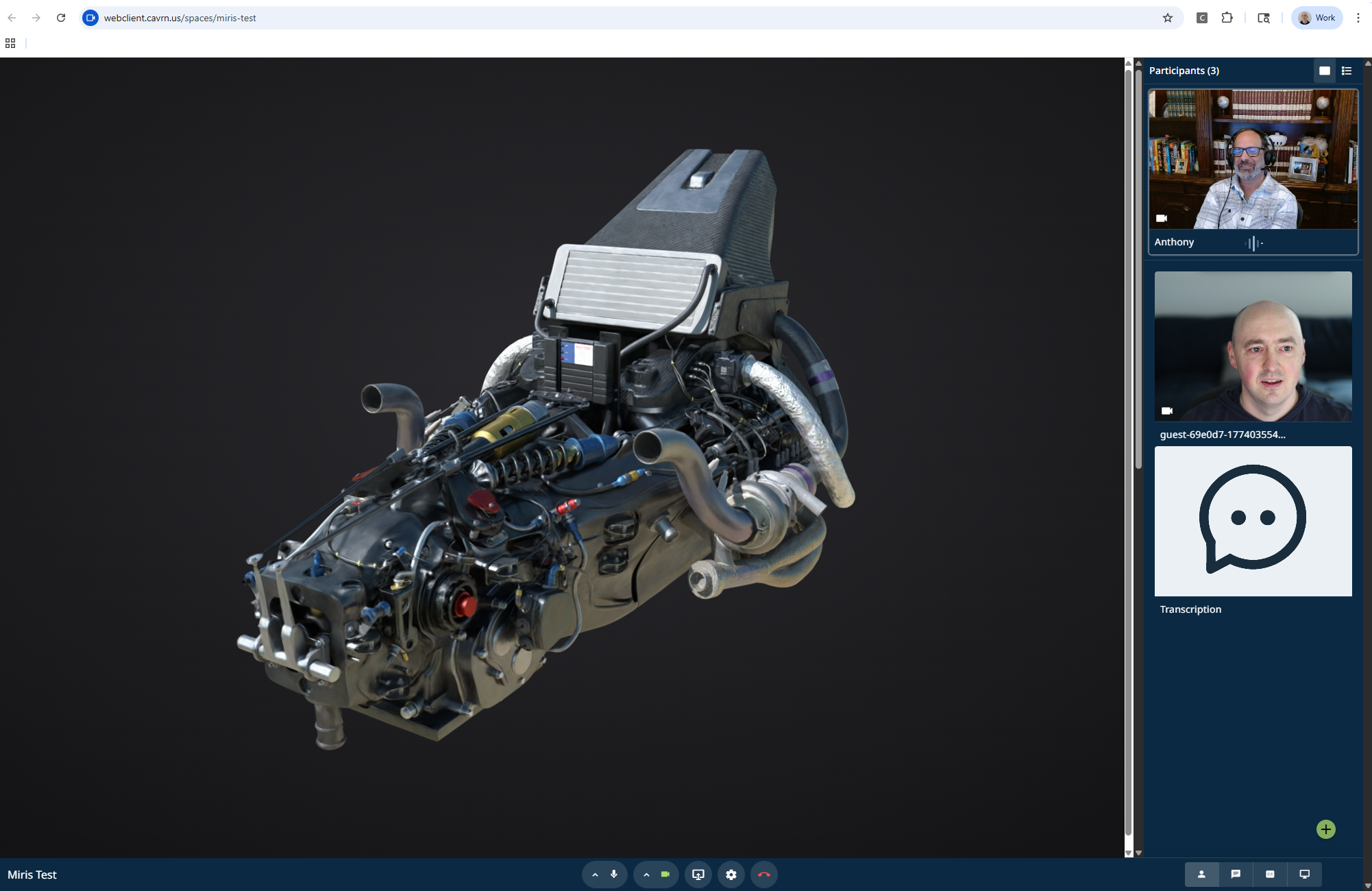
Cavrnus is built around making 3D applications and digital twins into live, persistent, collaborative spaces. Its platform provides real-time multi-user presence, voice and video, synchronized objects and data, and persistent session history across use cases that include design review, product development, connected digital twins, training, and industrial workflows.
That foundation matters because collaborative 3D review is not just about putting a model on a screen. It is about presence, context, and continuity: the ability to keep decisions attached to the scene where those decisions were made, and to return to that context days or weeks later without rebuilding it from scratch. Cavrnus is designed to make those interactions native to the 3D environment rather than layered on top of it through side channels.
Miris provides the streaming layer that makes high-fidelity 3D practical inside environments like Cavrnus. Rather than rendering scenes on cloud GPUs and transmitting video pixels to each participant, Miris streams actual 3D spatial data to each client device. Assets are processed upstream into a streaming-optimized representation and delivered progressively, adapting in real time to network conditions, device capability, content complexity, and user interaction.
Two consequences of that architecture are worth calling out directly in the context of collaborative review.
The first is cost structure. Because Miris does not provision a dedicated cloud GPU for each participant, the cost of a collaborative session does not scale the way pixel streaming would. Adding reviewers to a session behaves more like adding viewers to a content stream than like spinning up additional remote workstations.
The second is access. Miris streams high-fidelity 3D to any device. Participants joining on standard laptops or mobile hardware are not forced into a lower-fidelity version of the review. The asset adapts to each device's capabilities, but everyone is looking at the same streamed spatial data, not a different export optimized for their hardware tier.
Together, Cavrnus and Miris address the two things that have historically made high-fidelity collaborative 3D review difficult: getting the right people into the same environment, and getting the real asset into that environment with them.
Consider a product design team reviewing a furniture model before a client presentation. Under a typical workflow, someone exports a compressed version of the asset, shares a link, and schedules a call where half the team joins on laptops not powerful enough to run the full file locally. Material details get missed. The client sees a different version than the one the design team reviewed. Rounds multiply. While our integration is in development, what follows is how the combined workflow is designed to work.
Step 1: The team opens a shared Cavrnus space. Cavrnus provides a persistent environment with synchronized session state, so everyone joins the same context. The conversation happens inside the space, not around it.
Step 2: Miris streams the real asset into that environment. Rather than pushing a large file to every participant or substituting a reduced proxy, Miris serves as the streaming layer. Assets are uploaded once (Miris accepts OpenUSD, images, and video), conditioned for streaming in hours, and delivered progressively based on each participant's device and network conditions. No one is waiting for a full download before the review can start.
Step 3: The team reviews in context. Stakeholders inspect the same asset at the same time. They can examine material response, surface detail, and spatial relationships. Annotations and measurements attach to the shared scene, not to a screenshot captured afterward.
Step 4: The history persists. When the asset changes, the team returns to the same space. Prior annotations and discussion context are still there. The next round of review starts from where the last one ended, not from a blank slate.
The big change is Step 2. The gap has always been delivering the real asset into that collaborative environment at a quality level that makes inspection meaningful.
The Cavrnus and Miris integration is relevant anywhere that 3D content is reviewed collaboratively and fidelity matters to the decision being made.
Design review is the clearest use case: product, industrial, and architectural teams reviewing models before fabrication, client presentation, or production sign-off. Digital twin walkthroughs are a close second: distributed teams navigating facility models or infrastructure datasets together, where the ability to inspect actual captured detail (not a simplified stand-in) changes the quality of decisions made in the field. Training workflows are another: reviewing procedural simulations or spatial environments with participants who may be distributed across locations and devices.
In each of these cases, the current workaround is some combination of local GPU sessions, simplified exports, and screen sharing. The common limitation is the same: the asset the team reviews is not the asset that ships or gets built.
Miris Public Beta is free and available now. If you want to see how spatial streaming works before the Cavrnus integration ships, sign up and stream your first asset in minutes. Miris accepts OpenUSD, images, and video, with SDK support for three.js and Unity.
Cavrnus support for Miris is in development. Create a Cavrnus account today to get started with their collaborative environment and be positioned when the integration launches.
Cavrnus brings the persistent collaborative space. Miris brings the streaming layer. Together, they help ensure the asset your team approves is the same asset that ships.
.jpg)