Product updates
Miris now supports glTF intake

Laurie Koenig
July 21, 2026
•
5 min read

OpenUSD remains the preferred source format for rich production pipelines, while glTF is the most widely deployed runtime format for interactive 3D. By accepting both, Miris allows customers to start with the assets they already have, eliminating unnecessary conversion steps while delivering the same high-quality streaming experience.
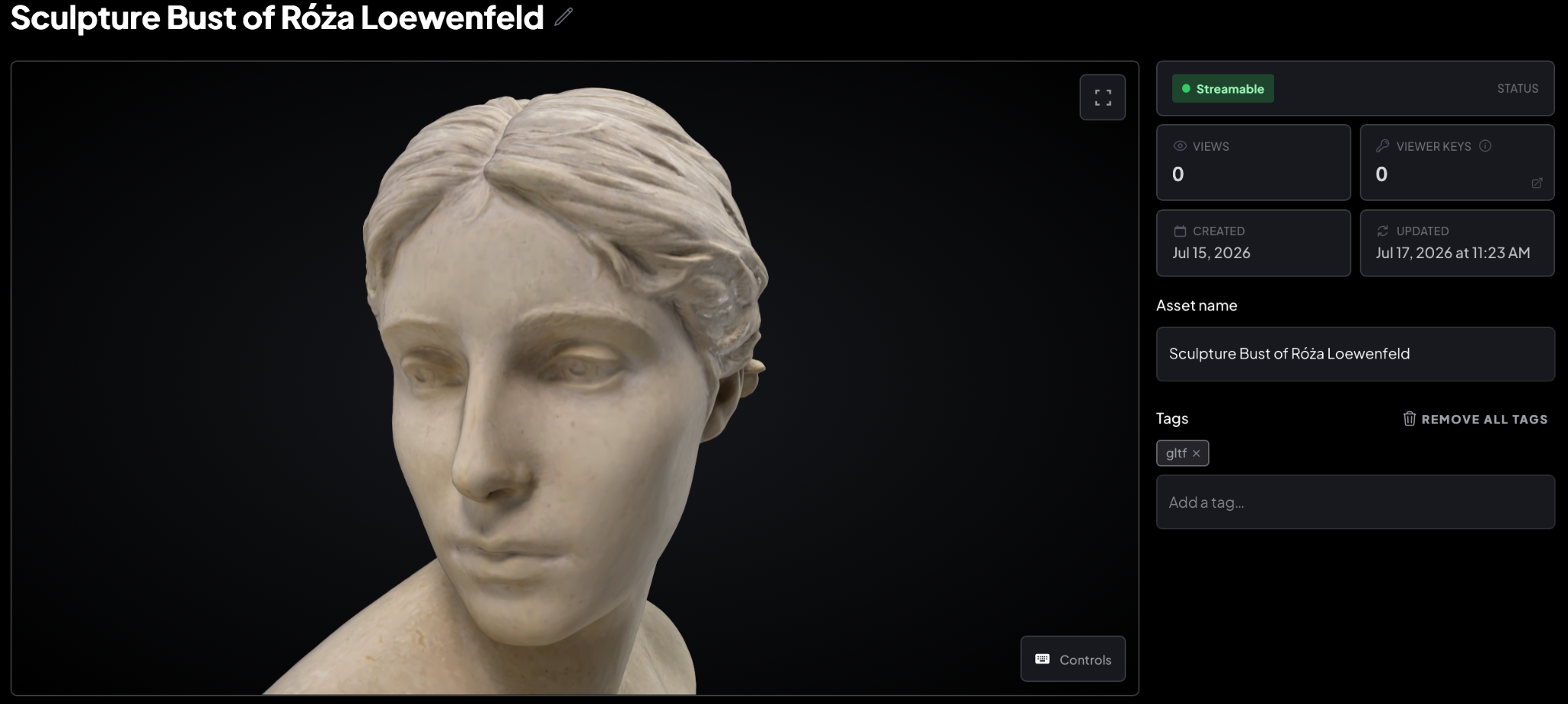
glTF has been the practical delivery format for real-time and web 3D for years, and is prevalent for good reason: broad tool support, an open specification, and a runtime that fits how the web works. Your team can continue to use glTF assets where they are needed and upload the same assets to Miris for streaming delivery. Miris can quickly stream to multiple devices, across varied internet connection speeds, while preserving the fidelity of your assets.
You can now import glTF files into the Miris platform at the quality you want to deliver. Our adaptive streaming provides exactly what a given device and connection can use, without having to spend time upfront optimizing for each target or worrying about levels of detail. Miris converts glTF assets so they can be rendered with advanced visual effects beyond what is available in real-time glTF viewers, such as higher-fidelity lighting and material appearance, without changing the source asset. When the streaming asset is delivered, the Miris platform handles all optimization while staying true to the visual intent of the asset, removing the need to wait for large asset downloads.
For developers, the practical change is that you can skip all of the optimization - Miris will ingest your highest quality assets and stream them quickly, adaptively, and with the fidelity that you need.
For artists and asset owners, the detail you author is the detail that gets delivered. Make the asset as good as it needs to be, and let delivery be our problem.
Miris now ingests glTF alongside OpenUSD. If your library already contains glTF, upload them straight to Miris, with no conversion to OpenUSD required on your side.
No. You don't convert glTF to OpenUSD yourself - Miris reads them directly. You can also skip any optimization such as mesh decimation, texture size reduction, or compression.
With direct glTF delivery, the viewer needs to download large amounts of data before the asset even appears, so teams trim geometry and textures to keep load times reasonable. Miris streams instead: the asset loads progressively and adapts to the viewer's device and connection, so a phone on a weak connection and a workstation on a fast connection each get the appropriate content.
Upload a glTF asset to Miris, and explore streaming using our platform in minutes. Sign up for the Miris Public Beta.
If your assets are already authored in OpenUSD, or you don’t have a glTF asset pipeline, we recommend using OpenUSD for optimal fidelity. See our guides for common DCCs
The Miris Public Beta is free. If your assets already live in glTF, the fastest way to see the difference is to upload one at full fidelity and watch how it streams. Stream your first 3D asset free. Sign up for the Miris Public Beta.
.jpg)