Product updates
Miris spatial streaming is now available in FiftyOne

Kellan Cartledge
June 1, 2026
•
8 min read
.jpg)

In March, we announced that Miris and Voxel51 were closing the last-mile gap for Physical AI teams. The thesis was simple. Physical AI teams have the 3D data. What they lacked was a lightweight way to visualize it at full fidelity. Loading a complex spatial scene meant a workstation-class GPU. Sharing it meant shipping multi-gigabyte files or standing up a pixel streaming rig. Scaling visualization across distributed teams multiplied the cost.
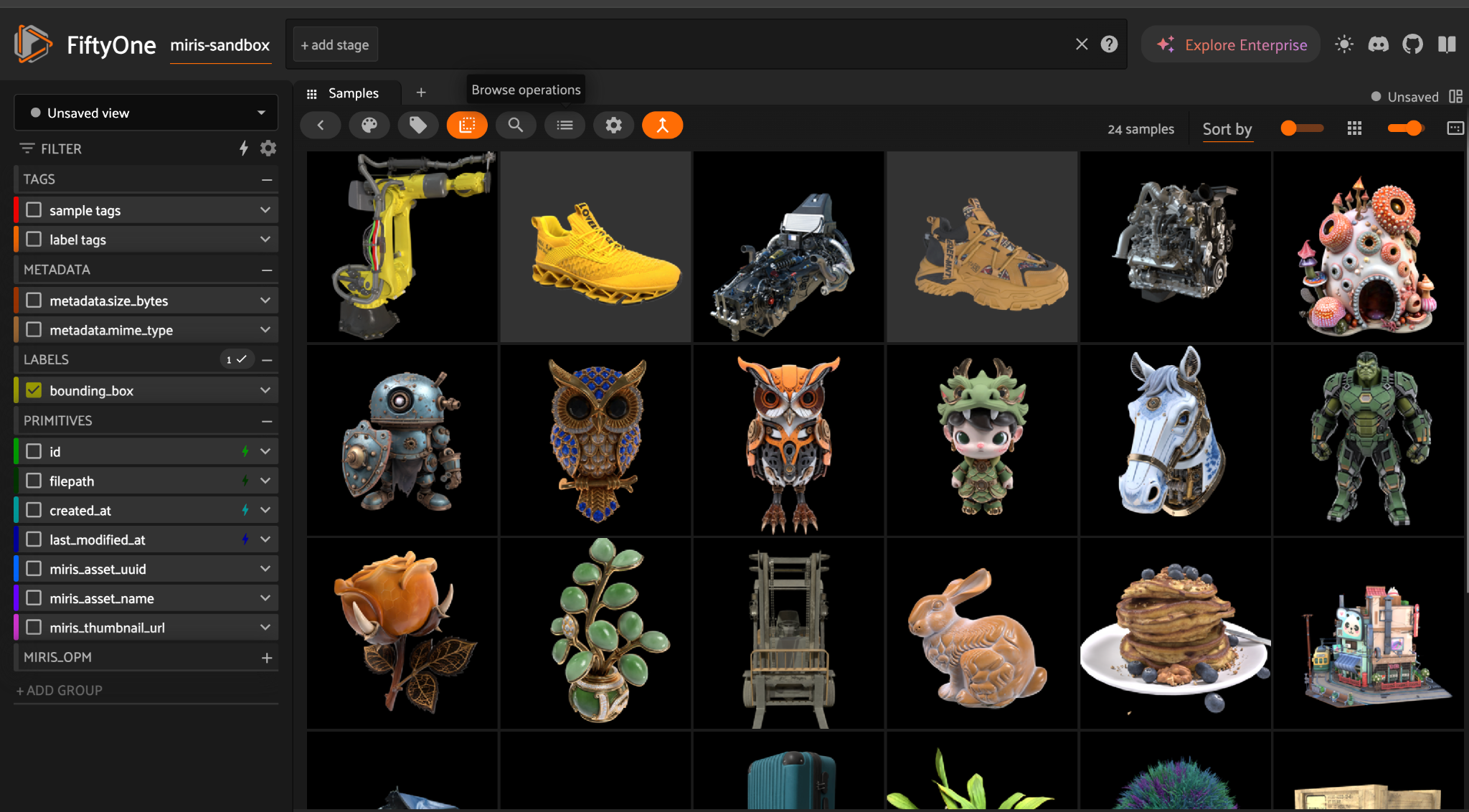
The open source Miris plugin for FiftyOne is now available, supported on both the open source release and the enterprise platform. Update your FiftyOne build, add the Miris plugin, drop in your viewer key, and any Miris-conditioned asset streams directly into FiftyOne's native 3D viewer. Labels, annotations, and metadata work in context alongside the 3D content, out of the box.
The plugin ships with a sample automated 3D annotation workflow that teams can run end-to-end without writing custom code. The sample uses FiftyOne's existing annotation tooling to run computer vision directly against Miris streams, generating bounding boxes and sub-object labels (for example, identifying wheel components within a streamed vehicle) on photorealistic spatial content. The workflow runs against the sample 3D dataset already available to FiftyOne users.
Spatial streaming inside FiftyOne does two things for Physical AI teams at once.
It broadens the audience. Any engineer with a browser tab and a Miris viewer key can now work with full-fidelity 3D data on the device they already have. The dependency on a workstation-class GPU at the visualization layer is gone. And because Miris streams only the spatial data needed for the current view rather than requiring the full asset in memory, even very large scenes (multi-gigabyte reconstructions, kilometer-scale environments) become workable on standard hardware. Distributed teams, reviewers, and annotators inspect the same source content without rebuilds, downloads, or per-user pixel streaming infrastructure.
It raises the floor. Because Miris streams full-fidelity, photorealistic 3D, computer vision models can recognize what is in the stream and do work that point cloud representations make difficult. And because Miris streams refine progressively, that signal is usable from the earliest frames of the stream, not only once full fidelity has resolved. Bounding boxes, object detection, and sub-component labeling can run directly against a streamed scene rather than against a sparse point cloud or compressed mesh. The starting quality of the data improves, and so does the speed of producing a clean, labeled dataset.
Taken together, Miris and Voxel51 help reduce the total cost of ownership for Physical AI development. Clean, hygienic, well-labeled training data is the input which decides how downstream models perform. Accelerating the speed of high-quality datasets enables teams to ship faster. Those who have to wait through downloads, work around fidelity loss, or maintain bespoke visualization infrastructure pay for that overhead in every cycle.
Here are three workflow patterns the Miris and FiftyOne integration unlocks for Physical AI teams.
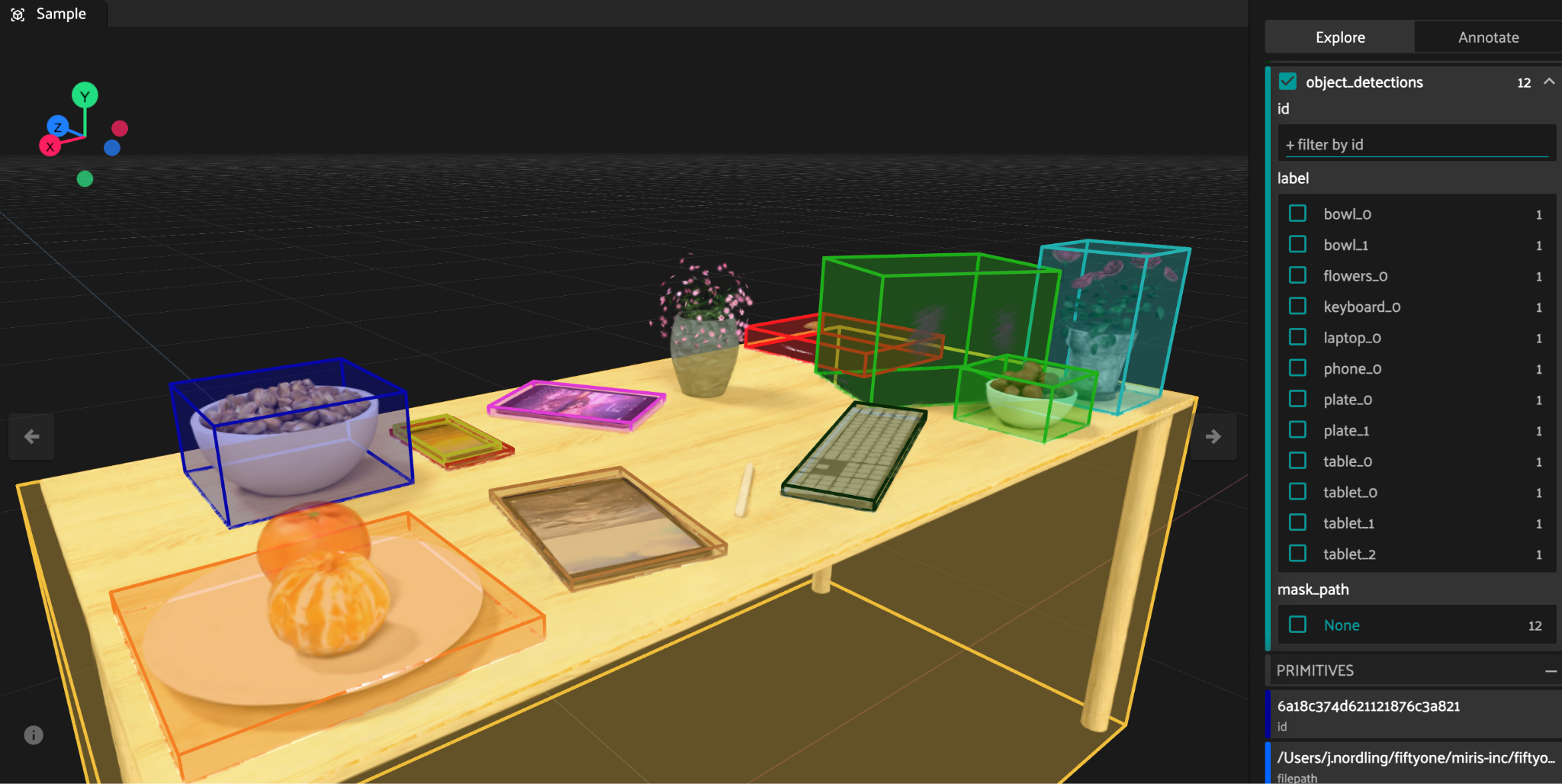
Scene review and training dataset curation. A self-driving or robotics team reconstructs an urban intersection from a drive or a captured scene. Reviewing that reconstruction no longer means downloading gigabytes or terabytes to a local workstation, or provisioning a pixel-streaming GPU. The scene streams directly into a FiftyOne tab alongside the dataset's labels and annotations. Teams compare scene versions, find the issues, and curate the right samples for training, without leaving FiftyOne.
Manufacturing and defect inspection. QA teams capture high-resolution 3D scans of components and stream them on demand. Switching between samples takes seconds rather than minutes. Engineers inspect surface detail, slice by defect type, and surface outliers to build targeted training sets.
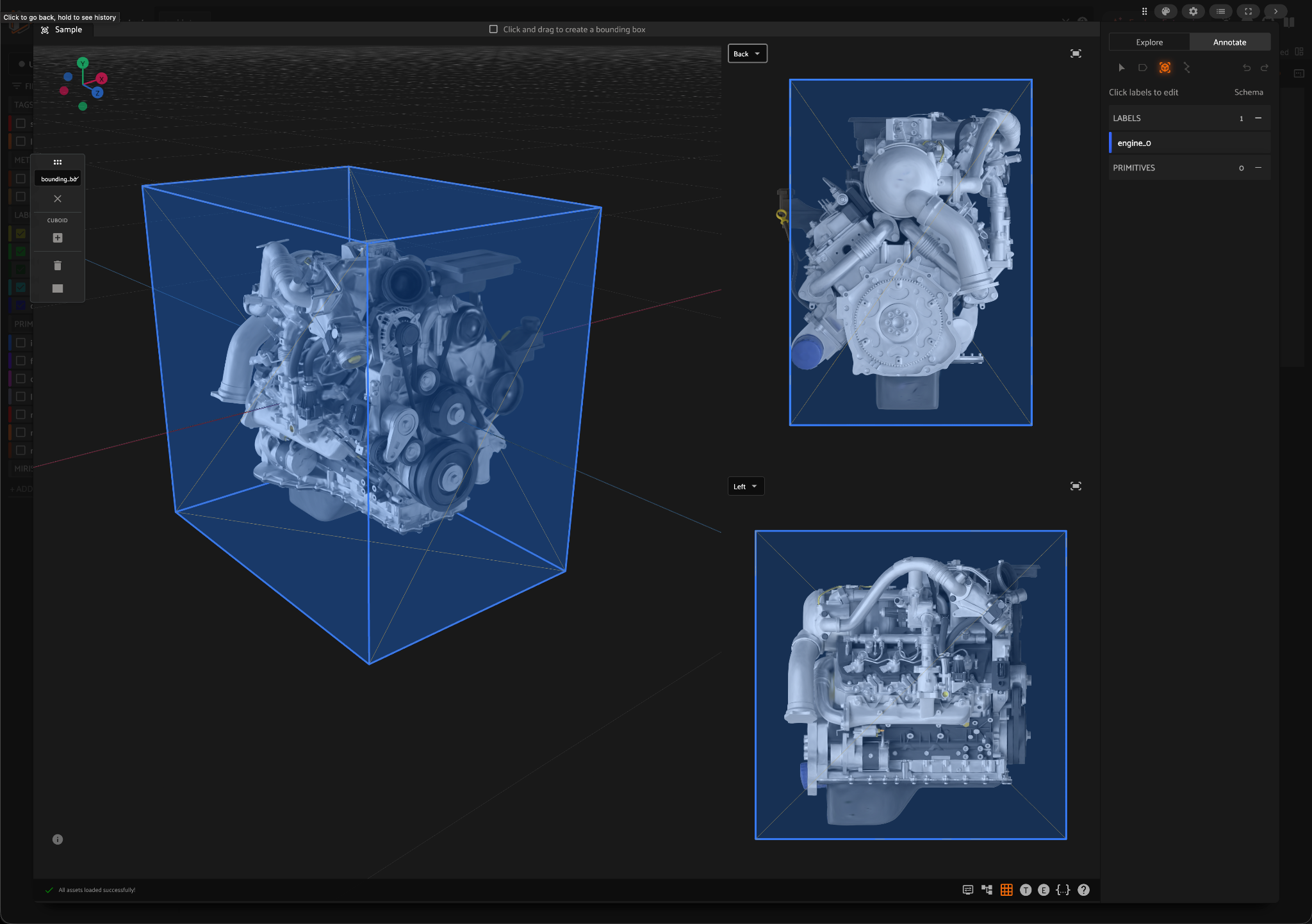
Automated 3D annotation pipelines. New in this release. The Miris plugin demonstrates running computer vision against Miris streams using FiftyOne's existing annotation tooling, with sub-object classifications such as wheel components within a streamed vehicle. The same approach is hard to run cleanly on sparse point clouds or low-resolution meshes, because there is not enough visual signal for a CV model to lock onto. Photorealistic streams give the model what it needs. The workflow runs against FiftyOne's existing sample 3D dataset, no custom data required.
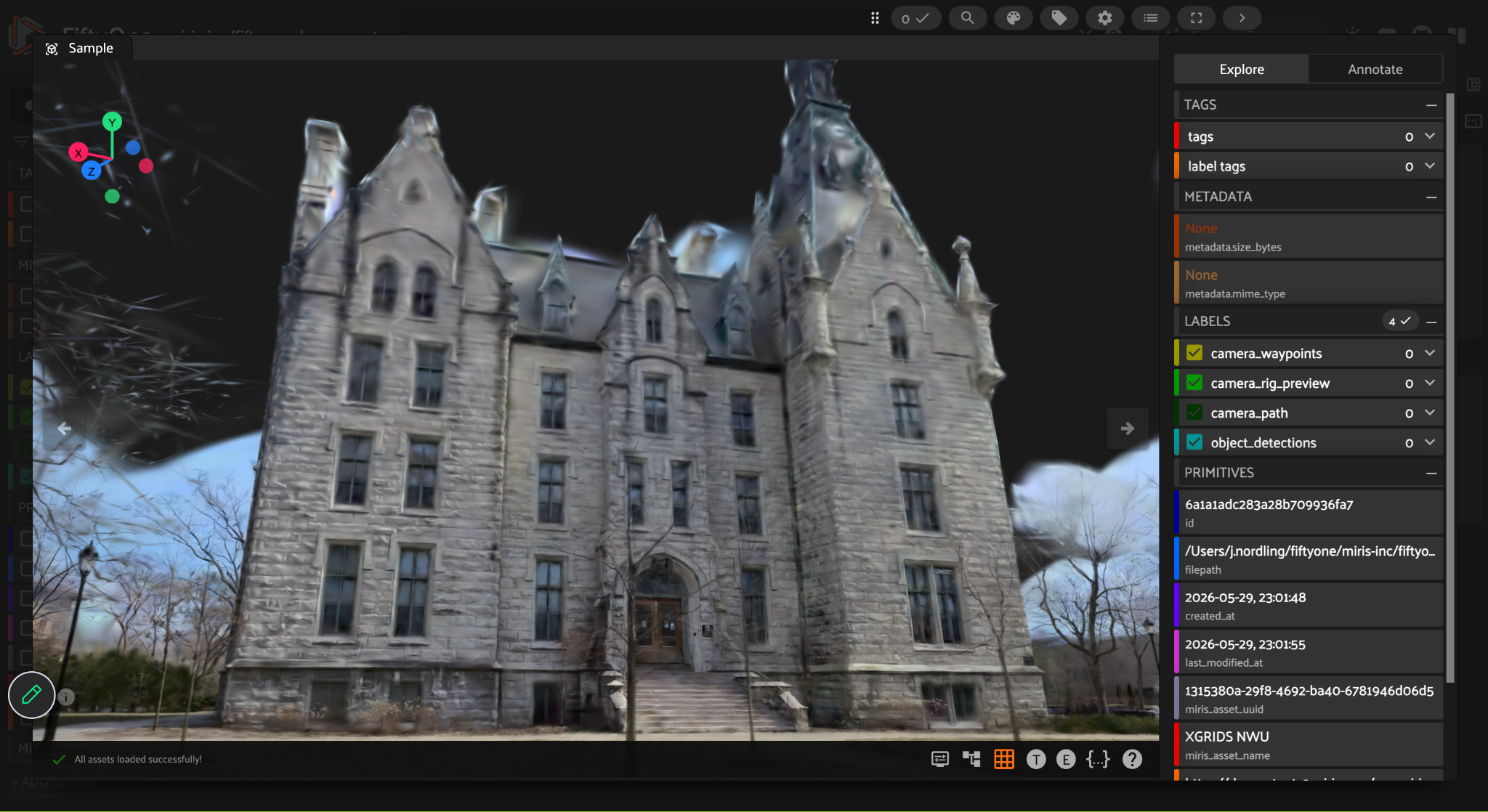
Come see Miris streaming live in FiftyOne at CVPR June 3rd to June 7th. Miris will be giving theatre talks in the Voxel51 booth on Friday, June 5, and Saturday, June 6, at 11 a.m. and 3 p.m. PT. Come ask the hard questions, see a live stream, and walk through your own workflow with the team.
If you can't wait until CVPR, you don't have to.
The Miris Public Beta is free and includes full SDK access for web (three.js). If you are building 3D reconstruction pipelines, explore the FiftyOne Physical AI Workbench.