The challenge
Physical AI teams run on 3D data. Reconstructed environments, spatial scans, and photorealistic scenes captured from sensors and cameras are the raw material for every model they train. But visualizing that data at full fidelity has always required hardware most of the team does not have.
Loading a complex spatial scene meant a workstation-class GPU. Sharing it with a reviewer, an annotator, or a distributed colleague meant shipping multi-gigabyte files or standing up a pixel streaming rig for that session. Scaling visualization across a team multiplied both the infrastructure cost and the coordination overhead. Every cycle spent on that overhead was a cycle not spent on improving the dataset.
The challenge is compounded at the annotation layer. Sparse point clouds and compressed meshes do not carry enough visual signal for computer vision models to run cleanly against them. Sub-object classification, bounding box generation, and object detection all degrade when the underlying representation loses photorealism. Teams working with low-resolution inputs accepted that tradeoff or found manual workarounds.
Why Voxel51 chose Miris
Voxel51 integrated Miris as the native, first-party 3D streaming provider in FiftyOne because it resolved the visualization bottleneck without requiring changes to the underlying data workflow. Assets process once upstream through Miris, then stream adaptively into FiftyOne with no cloud GPU required per viewer. Labels, annotations, and metadata travel alongside the 3D content, in context, out of the box.
How Voxel51 uses Miris
Miris is now a native, first-party 3D streaming provider inside FiftyOne, supported in both the open-source release and the enterprise platform. The integration is intentionally low-friction: update to the latest FiftyOne build, add the Miris plugin, drop in a Miris viewer key, and any Miris-conditioned asset streams directly into the FiftyOne viewer. No rebuild. No separate infrastructure required.
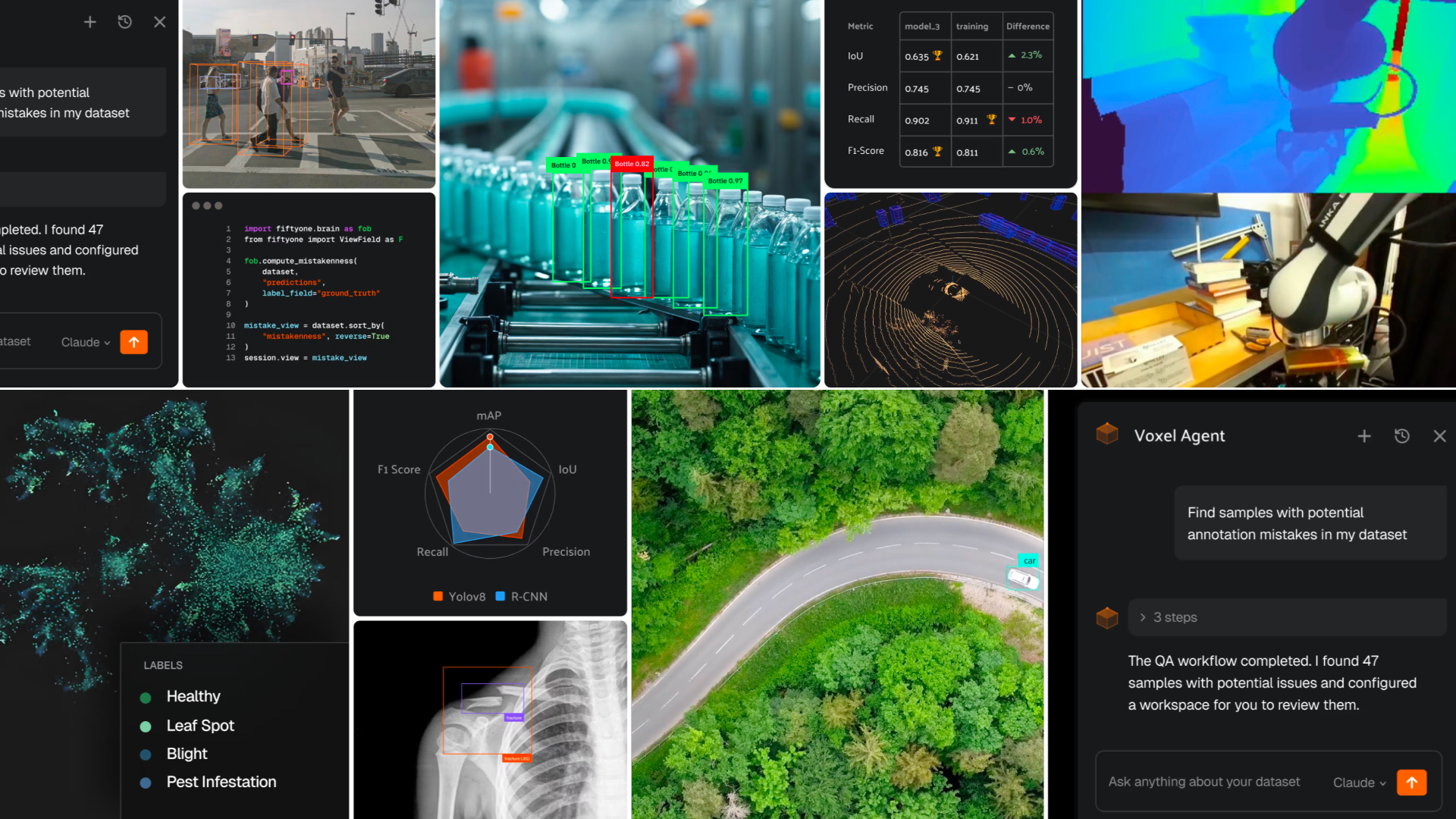
Alongside the core integration, the Miris plugin for FiftyOne packages sample workflows so teams can run the integration end-to-end without writing custom code. The headline workflow is automated 3D annotation: computer vision models run directly against Miris streams to generate bounding boxes and sub-object labels on photorealistic spatial content, including sub-component classifications like individual vehicle components within a streamed scene.
Three workflows are live for FiftyOne users on Miris today:
- Autonomous systems scene review. Teams reconstruct spatial environments and stream them directly into FiftyOne alongside dataset labels and annotations, without downloading to a local workstation or provisioning per-session GPU compute.
- Manufacturing and defect inspection. QA teams stream high-resolution 3D component scans on demand, switching between samples in seconds rather than minutes, and curating targeted training sets without leaving FiftyOne.
- Automated 3D annotation. Computer vision models run against Miris streams to generate annotations in 3D, including sub-object classifications that are difficult to produce cleanly from sparse point clouds or low-resolution meshes.
Results
Any engineer with a browser tab and a Miris viewer key can now work with full-fidelity 3D data on the device they already have. The dependency on a workstation-class GPU at the visualization layer is removed. Multi-gigabyte reconstructions and kilometer-scale environments stream on standard hardware, because Miris delivers only the spatial data needed for the current view rather than requiring the full asset in memory. Distributed teams, reviewers, and annotators inspect the same source content without rebuilds, downloads, or per-user pixel streaming infrastructure.
At the annotation layer, photorealistic streaming expands what is possible. Because Miris delivers full visual fidelity, computer vision models have enough signal to run detection and classification tasks directly against the stream. Sub-object labeling that was difficult or impractical on point cloud representations becomes a standard pipeline step.